What Causes Black Mold in a House?

What causes black mold is, at the level that matters, a very short answer: water. Mold spores are already in your house — they are in every house, they arrive through open doors and on clothing, and there is no realistic way to eliminate them. What decides whether they germinate and grow into a visible colony is whether they land somewhere that stays wet.
That reframing is useful, because it means the question is not "how did mold get in?" It is "where is water sitting for longer than it should?" Answer that and you have solved the problem. Skip it and you will be cleaning the same wall indefinitely.
Below are the eight sources that account for the overwhelming majority of household cases, roughly in order of how often they turn out to be the culprit.
From Sukie's experience
Our basement mold took me four months to solve because I kept treating the wall. The actual cause was a downspout discharging about eighteen inches from the foundation — every heavy rain pushed water against that corner, and it wicked up through the block. Moving the discharge two metres away with a length of drainpipe did more than every bottle I bought.
The three conditions mold needs — and the only one you control
Mold requires three things simultaneously: spores, a food source, and moisture. Removing any one of them stops growth.
Spores cannot practically be removed. They are ubiquitous outdoors and they enter every building continuously. Air purifiers reduce airborne concentration but do not sterilise a house, and nothing you buy will change this.
Food also cannot be removed, because it is the building. Mold metabolises cellulose and other organic material — the paper facing on drywall, wood framing, cotton and wool fabrics, dust, wallpaper paste, ceiling tiles, cardboard stored in a basement. You cannot construct a house out of nothing digestible, and even inorganic surfaces like tile and concrete accumulate a thin film of dust and soap residue that will feed a colony.
Moisture is the variable. It is the only one of the three you have real leverage over, and it is why every credible source on mold — the EPA included — leads with moisture control rather than with cleaning products.
The threshold is lower than most people expect. Mold does not need standing water. Sustained relative humidity above roughly 60%, or a surface that stays damp, is sufficient. The commonly cited window is that materials wet for 24 to 48 hours become vulnerable — which is why a spill dried promptly causes no problem and the same spill under a rug causes a colony.
Cause 1: Condensation on cold surfaces
This is the single most common cause in homes that have not had a leak, and the most misunderstood, because there is no obvious water anywhere.
Warm air holds more moisture than cold air. When warm humid indoor air contacts a cold surface, it cools, its capacity to hold water drops, and the excess condenses onto that surface. Do that every night for a winter and you have a permanently damp patch with no leak to find.
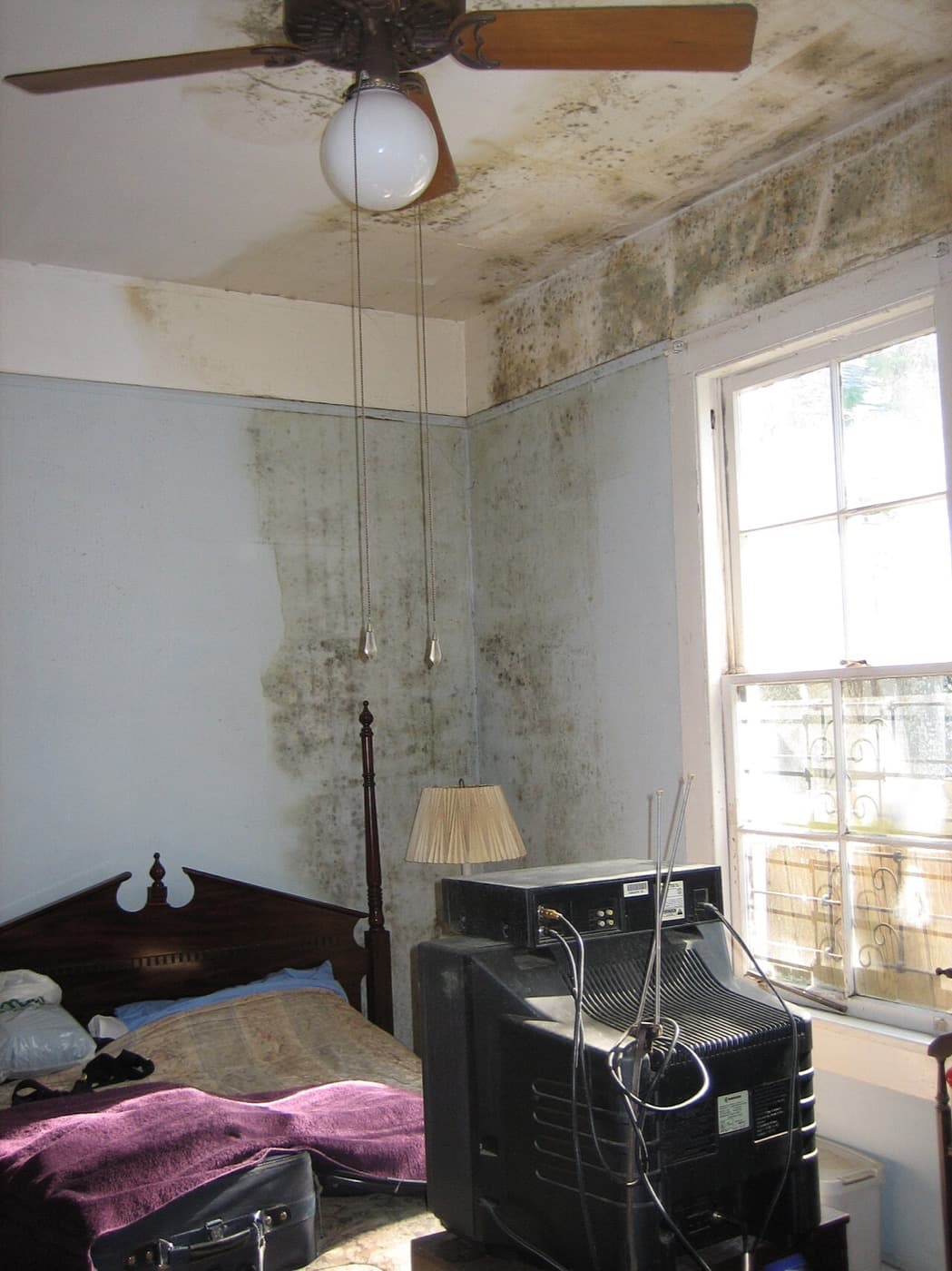
Where it shows up: exterior-facing wall corners, especially north-facing ones; behind furniture pushed flat against an outside wall, where air cannot circulate; around window frames and on the reveals beside them; on uninsulated sections of ceiling below a cold roof space; on cold water pipes running through warm rooms; behind and inside wardrobes on external walls.
The tell is the pattern — growth concentrated in corners and worst at the top, or in a distinct band where insulation ends. If your mold is in a corner rather than in a patch, condensation is your most likely answer, and the fix involves heating, ventilation and insulation rather than plumbing.
Not sure if it's a DIY job or a pro job?
Get a ballpark price first, then decide.
Estimate my removal cost →Cause 2: Bathroom humidity that never leaves
A ten-minute hot shower puts a remarkable amount of water vapour into a small room. Where it goes next determines whether you get mold.
The failure is almost always ventilation rather than the shower itself. Common versions: no extractor fan at all; a fan wired to the light switch so it stops the moment you leave, precisely when it is most needed; a fan that vents into the attic or roof space rather than outside, which relocates the problem rather than solving it; a fan too weak for the room; or a fan whose ducting has come adrift, so it has been blowing into a wall cavity for years.
The practical fix is unglamorous and effective: run the extractor for fifteen to twenty minutes after you finish, leave the door ajar so replacement air can enter, and squeegee the shower walls. Our page on black mold in the bathroom covers the specifics, including why grout and caulk fail first.
Cause 3: Plumbing leaks you cannot see
Concealed leaks are the cause that does the most damage before discovery, because a slow drip inside a wall cavity can run for months before anything appears on the surface.
Usual suspects: supply-line connections under sinks; the joint behind a toilet where the supply enters; shower valve bodies inside the wall; washing machine and dishwasher hoses; and the drain connection under a tub, which is invisible from every direction.
Signs worth acting on: a musty smell with no visible growth; a section of floor or skirting that is discoloured or lifting; paint bubbling in a patch rather than along a line; a water bill that has climbed without explanation; and warm or cold spots on a floor where a pipe runs beneath.
If growth appears on a wall shared with a bathroom, kitchen or laundry, treat concealed plumbing as your leading hypothesis. See black mold behind drywall for how to investigate without demolishing the room.
Cause 4: Roof, gutter and flashing failures
Water entering from above produces some of the most extensive growth, because it travels — running along joists and inside cavities before appearing somewhere unrelated to its entry point.
Typical failures are damaged or lifted shingles, cracked or corroded flashing around chimneys, vents and valleys, blocked gutters overflowing back against the fascia, and downpipes discharging against the wall rather than away from it.
The signature is vertical: staining or growth that runs downward from the ceiling line, worst after heavy rain, sometimes appearing in a different room from the actual defect. If growth in an upstairs room correlates with weather, start on the roof rather than in the room.
Cause 5: Ground moisture in basements and crawl spaces
Below-grade spaces face a problem no other part of the house has: they are surrounded by soil that holds water, and concrete and masonry are not waterproof. Water moves through them by capillary action even without a crack or an obvious leak.
Contributing factors: ground sloping toward the house rather than away; downpipes discharging beside the foundation, which is astonishingly common and trivially fixable; failed or absent damp-proofing; a high water table; and — a distinctly summer problem — warm humid outdoor air entering a cool basement and condensing on every cold surface, which is why opening basement windows in July usually makes damp worse rather than better.
Crawl spaces have their own version, where an unsealed earth floor evaporates ground moisture continuously into the space above. Our guides to basement mold and crawl space remediation cover both.
Cause 6: Appliance and HVAC issues
Several appliances handle water routinely, and any of them can become a mold source when something goes slightly wrong.
Air conditioning is the one people miss. An AC system removes humidity from air and has to put that condensate somewhere. A blocked condensate drain line backs water up into the unit and the surrounding structure; an oversized system cools the room quickly and shuts off before it has dehumidified, leaving a cool damp house. Both produce mold, and mold inside ducting is particularly serious because the system distributes spores through the whole house — see black mold in air vents.
Also worth checking: refrigerator drip pans and ice-maker lines; washing machine door seals, which grow mold in the rubber gasket almost universally on front-loaders; dishwasher seals; and tumble dryers vented internally rather than outside, which is effectively a humidifier.
Cause 7: Flooding and one-off water events
Flooding causes obvious problems, but the interesting failures are the near-misses that got cleaned up inadequately — a burst washing machine hose mopped up in an afternoon, a bath left running, a window open during a storm.
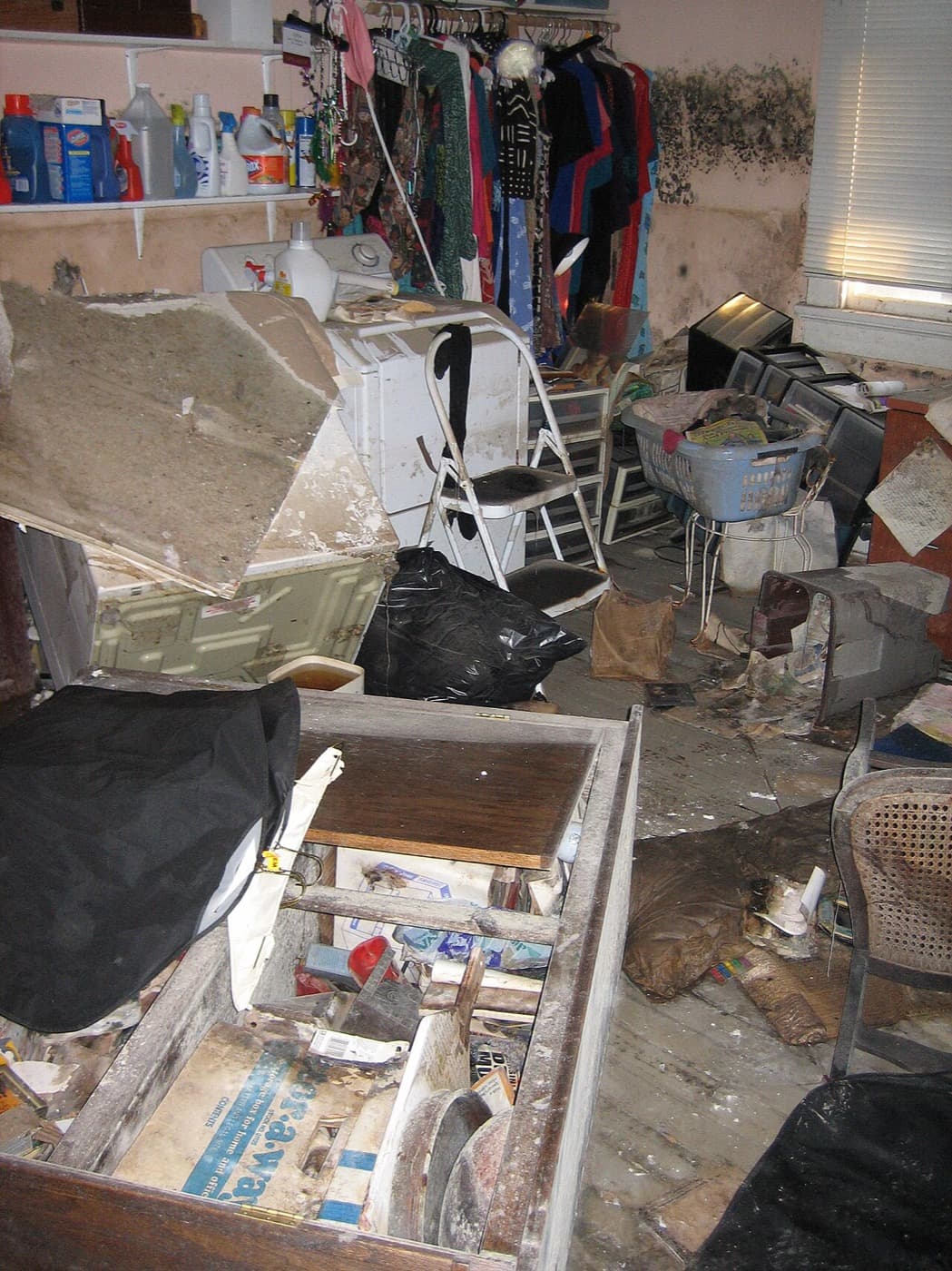
The issue is that surfaces dry long before structures do. A floor can feel dry while the subfloor beneath it and the bottom plate of the wall beside it hold moisture for weeks. If mold appears weeks or months after a water event that seemed resolved, the water was never fully removed — it just stopped being visible.
Flood water also brings contamination beyond the mold itself. If the water was groundwater or sewage, the CDC's guidance is unambiguous that this is professional territory rather than a homeowner cleanup.
Cause 8: The house being too airtight for how it is lived in
This one is worth naming because it is increasingly common and rarely diagnosed. Modern weatherproofing, replacement windows and added insulation dramatically reduce air leakage — good for energy bills, but it removes the accidental ventilation older houses relied on.
Meanwhile, ordinary living generates a lot of moisture: cooking, showering, drying laundry indoors, houseplants, and simply breathing. Estimates for a family of four run to several litres of water vapour per day. In a leaky old house that moisture drifted out through gaps. In a sealed one it stays, condenses on the coldest surface available, and grows mold there.
The signature is mold appearing in several unrelated places at once, often after energy-efficiency work, with no leak to find anywhere. The fix is deliberate ventilation to replace the accidental kind — trickle vents, extractor fans that actually run, and drying laundry outside or in a vented machine rather than on a rack in the living room.
Working out which one is yours
A short diagnostic sequence gets most people to an answer.
- Where is it? Corners and window reveals point to condensation. A defined patch mid-wall points to a leak behind it. High on the wall or at the ceiling points upward — roof or plumbing above. Low down or at the skirting points to ground moisture or a floor-level leak.
- Does it correlate with anything? Worse after rain suggests roof, gutters or drainage. Worse in winter suggests condensation. Worse in summer, in a basement, suggests humid air condensing on cool surfaces. Constant suggests a plumbing leak.
- What is on the other side of that wall? A bathroom, kitchen or laundry on the far side makes concealed plumbing the leading candidate.
- What does a moisture meter say? Twenty to forty dollars, and it maps the wet zone rather than the stained zone — which are frequently different sizes.
- What is the room's humidity? A hygrometer under fifteen dollars settles whether you have a room-wide humidity problem or a localised water source.
Once you know the cause, the remediation itself is usually the easy part. Our guides on getting rid of black mold and preventing it returning cover the work, and if the job turns out to be bigger than a weekend, the cost estimator will give you a realistic range before you start phoning contractors.
Get a realistic price before you call anyone
Use our free Black Mold Removal Cost Estimator to get a tailored price range for your room, size, and severity — built from current national and regional pricing data. Then you'll know whether a contractor quote is fair before you commit.
Open the Cost Estimator →