Cost to Remove Black Mold From Drywall: A Realistic 2026 Guide

Cost to remove black mold from drywall usually falls between $1,000 and $6,000 in 2026, and where you land in that range comes down to one thing the homeowner can't always see: whether the mold is only on the painted surface or has soaked into the porous gypsum core. Surface mold on the paint can sometimes be cleaned. Mold that has penetrated the drywall almost always means cutting it out and replacing it — and that's where the cost climbs.
I learned this firsthand. When a slow leak rotted the wall behind my bathroom tub surround, what looked like a small stain on the surface turned out to be drywall so saturated it crumbled in my hand. There was no cleaning it — it had to come out. Below I'll break down what cleaning versus replacing actually costs, why drywall is treated differently from non-porous surfaces, and how to tell which situation you're in before you call anyone.
From Sukie's experience
The 'small stain' on my bathroom wall hid drywall so waterlogged that when I pressed it, my finger went straight through — that was the moment I understood why pros don't bother cleaning saturated drywall and just cut it out.
Surface mold vs. saturated drywall — the price split
Drywall is porous, so professionals treat it very differently from tile, glass, or sealed wood. The defining question is depth:
Surface-only mold (light growth on the paint, drywall still firm and dry behind it) can sometimes be cleaned and treated. Expect roughly $2–$8 per square foot for surface cleaning, often landing in the $200–$1,000 range for a small wall section.
Saturated or penetrated drywall (soft, stained-through, crumbling, or growth that returns after cleaning) has to be removed and replaced. This is the more common scenario for black mold, and it pushes the cost to $10–$30 per square foot all-in once you include demolition, disposal, new drywall, taping, and repainting. A modest affected wall typically runs $1,000–$3,000; larger or hidden-cavity jobs reach $6,000 or more.
The EPA is blunt about this in its home mold cleanup guidance: porous materials like drywall and ceiling tiles that are moldy usually need to be discarded, because you can't reliably get mold out of the material's interior.
What goes into a drywall mold quote
When a contractor prices a drywall mold job, you're paying for a sequence of steps, not just 'removing mold.' A typical replacement job includes:
- Containment — plastic sheeting and negative air to keep spores out of the rest of the house.
- Demolition — cutting out and bagging the contaminated drywall.
- Disposal — moldy material is handled as contaminated waste.
- Treating the cavity — cleaning and treating studs and framing behind the wall.
- Drying — ensuring the cavity is dry before closing it up.
- New drywall — hanging, taping, mudding, sanding.
- Finishing — priming with a stain-blocking sealer and repainting.
Two of these steps quietly drive the price: containment (because spreading spores during demo is the biggest risk) and finishing (taping and painting to match takes skilled labor). Cheap quotes that skip containment or proper priming tend to cost you later in either re-contamination or bleed-through stains.
Not sure if it's a DIY job or a pro job?
Get a ballpark price first, then decide.
Estimate my removal cost →Cost factors that move the needle
Two drywall jobs with the same square footage can differ by thousands. The biggest variables:
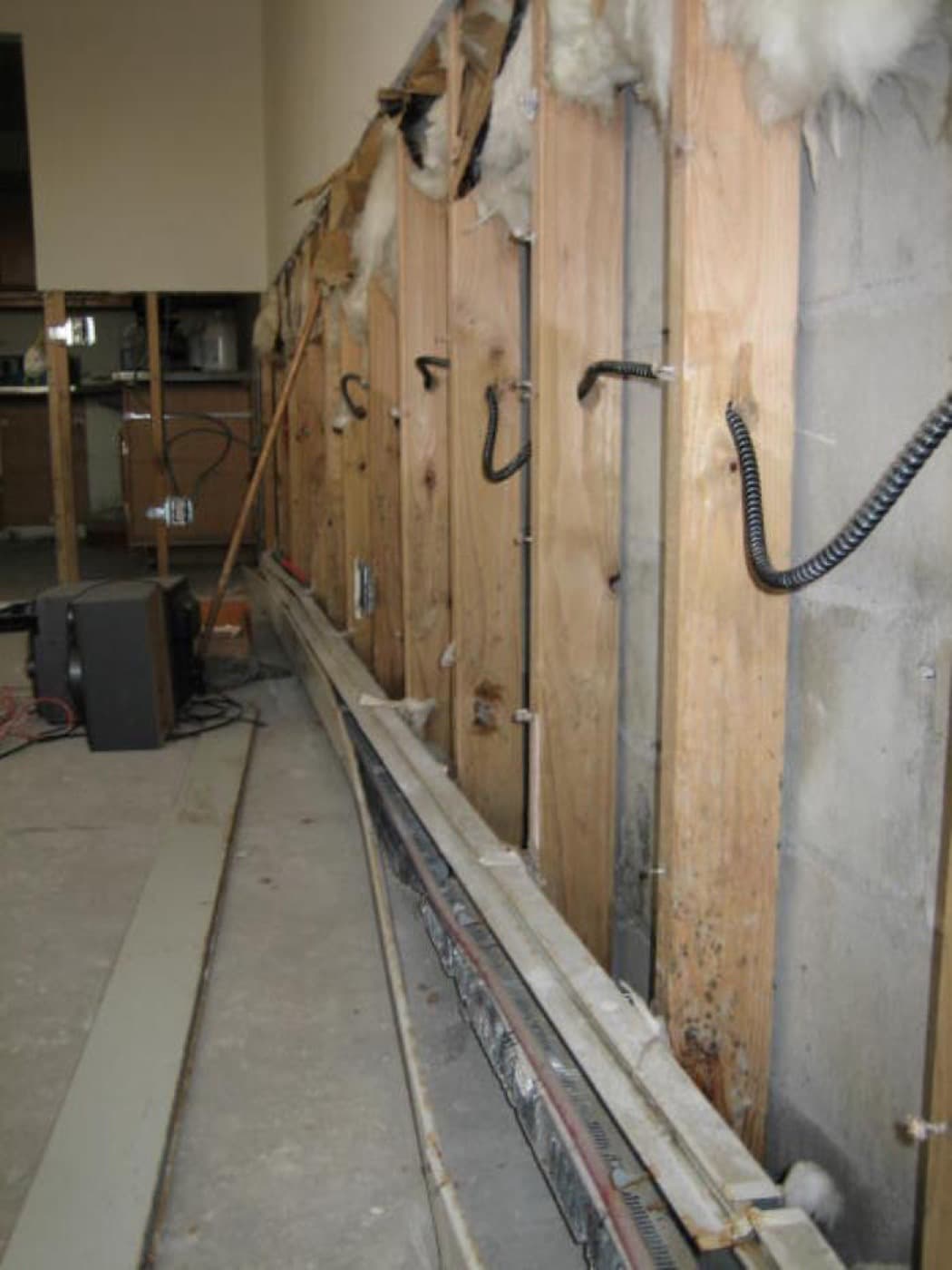
- Hidden vs. visible. Mold confined to the surface is cheap; mold inside the wall cavity (around plumbing or behind a leak) requires opening the wall and often finds more damage.
- The moisture source. A drywall fix is wasted money if you don't repair the leak, condensation, or humidity that caused it. That repair is a separate cost.
- Insulation. Wet, moldy insulation behind the drywall must be replaced — add $1–$3 per sq ft.
- Structural rot. If framing is rotted, repairs add $500–$3,000+.
- Finish complexity. Textured walls, wallpaper, or trim work raise the finishing cost.
- Testing. Pre- and post-remediation testing adds $300–$650 if you want verification.
For a quick gut check on typical figures, cost aggregators like HomeGuide and Angi both place drywall-area remediation in the $10–$30 per square foot range once removal and replacement are involved.
Can you clean moldy drywall yourself?
For genuinely small, surface-level spots on intact drywall, careful DIY is reasonable and can save the labor cost. The honest catch: black mold on drywall is often deeper than it looks, and disturbing it without protection releases spores. If you go the DIY route on a small spot, follow these rules:
- Fix the moisture source first — otherwise it returns.
- Wear an N95 respirator, gloves, and eye protection at minimum.
- Don't soak the drywall; over-wetting ruins it and spreads mold.
- Use a HEPA vacuum after cleaning to capture loose spores.
- If the drywall is soft, stained through, or the mold returns, stop and replace it.
The EPA's roughly 10-square-foot guideline is a useful line: above that, or for anyone with asthma or a compromised immune system, hire a certified pro. Drywall is cheap to replace and not worth risking your lungs over a confined, spore-heavy demo.
Should you repair or replace? A simple decision guide
Use this quick test to decide which way a section of drywall is headed:
Replace if the drywall is soft, swollen, stained all the way through, crumbling, or if the mold grows back after cleaning. Try cleaning if it's firm, dry behind the surface, and the growth is light and clearly only on the paint.
When in doubt, replace. Drywall material itself is inexpensive (a 4x8 sheet is around $15–$25), so the real cost is labor and finishing — and paying once for proper removal beats paying twice when surface 'cleaning' fails on saturated board. The most expensive outcome is cleaning, repainting, and then discovering the mold never left, because now you're paying for the replacement and the wasted first attempt.
How professionals actually price a drywall job
When you collect quotes, it helps to understand the math contractors use so you can read a bid critically. Most price drywall mold work one of two ways:
By the square foot. This is common for straightforward jobs. Surface cleaning runs about $2–$8 per square foot, while full removal and replacement runs $10–$30 per square foot all-in. A 60-square-foot section of saturated drywall at $20/sq ft works out to roughly $1,200 just for the wall, before moisture repair.
By project scope. For jobs with hidden mold, cavity work, or structural questions, contractors quote the whole project — containment, demo, disposal, cavity treatment, drying, new drywall, finishing — as one number, because the unknowns behind the wall make per-foot pricing unreliable.
A few things to verify in any bid: Is containment included? Is disposal of contaminated material included or billed separately? Does the price include priming with a stain-blocking sealer and repainting, or just bare new drywall? Is the moisture-source repair in this quote or a separate trade? The cheapest bid is frequently the one that quietly omitted finishing or containment, so compare what's in each number, not just the number itself. When two quotes are far apart, the difference is almost always in those omitted line items, not in the contractor's hourly rate.
Cost by room: where drywall mold usually shows up
The same drywall job costs differently depending on the room, mostly because of what's behind the wall and how much finishing it needs. Here's how typical drywall mold scenarios tend to price out:
- Bathroom walls: often $500–$2,000 for visible drywall, but mold hiding behind the tub surround or shower wall can push it toward $8,000 once you open the cavity (this is exactly what happened to me).
- Basement drywall: $1,500–$6,000, because basement moisture problems are usually chronic and the affected area is larger; wet insulation and framing often come into play.
- Bedroom or living-room walls: typically $1,000–$3,000 for a localized section from a roof or window leak, less if it's a small surface spot.
- Around windows: often smaller and cheaper, $300–$1,200, since the affected drywall is usually a confined band — but recurring condensation must be solved or it returns.
- Ceilings (drywall): add a premium for overhead work and the higher chance of a hidden leak above; $500–$2,500 is common.
The pattern: rooms with chronic moisture (bathrooms, basements) and hidden cavities cost the most, while a one-time leak in a dry room caught early is the cheapest to fix. Catching any of these while it's still a surface spot is the single biggest lever on the final bill.
Ways to keep the cost down without cutting corners
You can trim a drywall mold bill responsibly:
- Catch it early. A small surface spot cleaned promptly costs a fraction of a saturated wall.
- Fix the leak yourself if you're handy, so the contractor only handles remediation.
- Bundle inspection with remediation — many companies credit the inspection fee if you hire them.
- Get three itemized quotes and compare line by line, not just the bottom number.
- Don't skip containment or stain-blocking primer — those aren't the places to save.
What you should never do to save money is paint over visible mold. It hides the problem, traps moisture, and the stain and growth bleed back through — turning a $1,000 fix into a $4,000 one.
Get a realistic price before you call anyone
Use our free Black Mold Removal Cost Estimator to get a tailored price range for your room, size, and severity — built from current national and regional pricing data. Then you'll know whether a contractor quote is fair before you commit.
Open the Cost Estimator →