Black Mold Treatment: What Actually Works on Each Surface

Black mold treatment is a phrase I typed into a search bar at 11 p.m. with a flashlight in my other hand, standing in a bathroom where the caulk line had gone black and the wall behind it had gone soft. What I wanted was one product. What I needed was a table — because the right treatment for tile is wrong for drywall, the right treatment for wood is pointless on carpet, and the thing that looks like it worked on Saturday can be growing back by the following weekend.
So this page is that table, expanded. Twelve surfaces, what to use on each, and — the part most guides skip — what the controlled evidence says about the household chemicals people reach for. Where the U.S. EPA, the CDC or a peer-reviewed study has tested something, I say so and give the date I read it. Where nobody has, I say that too. To be clear at the outset: this is treatment for surfaces and rooms. If you are looking for what to do about symptoms after exposure, that is a different page — black mold exposure treatment at home.
From Sukie's experience
My bathroom taught me the difference between treating a surface and treating a problem. I scrubbed the tub surround three weekends running with a bleach spray and it came up white every time; on the fourth weekend I finally pulled the corner trim and found the grout had failed behind it, the backer board was wet through, and the black on the surface was the least of it. Two sheets of cement board, a new surround and a properly caulked corner fixed in four hours what three weekends of spraying had not.
The one rule that decides every treatment: porous or not
Before any product, ask whether the surface is porous. On a hard, sealed surface — tile, glass, metal — mold sits on top and can be removed. In a porous material — drywall paper, carpet, insulation, ceiling tile — it grows into the structure, and treatment cannot reach it. The EPA's rule is that "absorbent or porous materials, such as ceiling tiles and carpet, may have to be thrown away if they become moldy." The best experimental evidence agrees: a 2015 review in the International Journal of Environmental Research and Public Health describes a test in which five antifungal agents — including 17% hydrogen peroxide and bleach — inhibited six common indoor molds (among them Stachybotrys chartarum) on pine wood blocks within 12 hours, but once the agents were rinsed off the spores recovered, and two weeks later growth was "entirely uninhibited." The authors' conclusion: "most antifungals are effective on hard non-porous surfaces but viable spores within porous surfaces may be unaffected."
That is the whole treatment philosophy in two sentences. Non-porous: clean it. Porous: remove it. Semi-porous (wood, unsealed concrete): clean it, dry it thoroughly, and expect to monitor it.
The treatment matrix
| Surface | Porous? | Treatment | Keep or replace? |
|---|---|---|---|
| Ceramic tile, glass, porcelain | No | Detergent + scrub, rinse, dry; CDC bleach ratio optional | Keep |
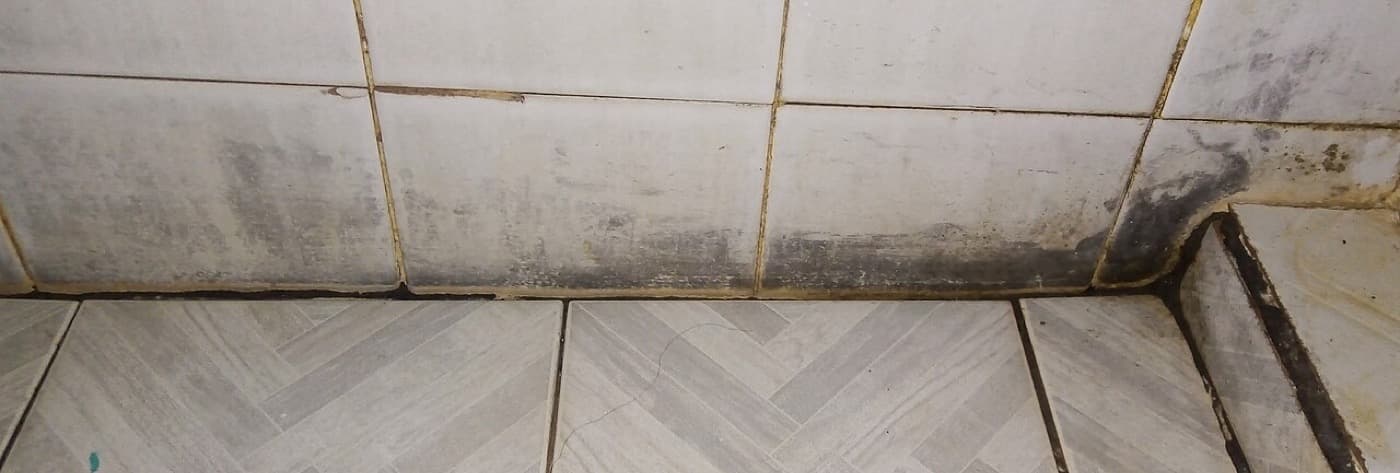
| Grout and caulk | Grout semi; caulk no (but mold gets under it) | Scrub grout; cut out and replace stained caulk | Re-grout if stained through; re-caulk |
| Painted drywall, surface only | Semi | HEPA-vacuum, damp detergent wipe, dry, monitor | Keep if firm and not stained through |
| Drywall, soft or stained through | Yes | None — cut out 12 in. past growth | Replace |
| Bare wood framing | Semi | HEPA-vacuum, detergent scrub, dry to meter, HEPA again | Keep unless structurally soft |
| Finished wood furniture | Semi | Vacuum, mild detergent, dry; refinish if stained | Keep |
| Concrete and masonry | Semi | Scrub with detergent, rinse, dry; address moisture through the wall | Keep |
| Carpet and pad | Yes | None | Replace |
| Insulation, ceiling tiles | Yes | None | Replace |
| Fabric, upholstery, mattresses | Yes | Launder hot if washable; otherwise none | Replace unless washable |
| Books and paper | Yes | None | Discard; freeze irreplaceable items for a conservator |
| HVAC ducts and air handler | Mixed | Not a DIY treatment | Professional duct cleaning; HVAC off until assessed |
The rest of this page takes each row in turn.
Not sure if it's a DIY job or a pro job?
Get a ballpark price first, then decide.
Estimate my removal cost →Tile, glass and sealed hard surfaces
The easy case. The CDC's current cleaning guidance is that mold "can be removed from hard surfaces with household products, soap and water, or a bleach solution of no more than 1 cup of household laundry bleach in 1 gallon of water." Use the first two options first; physical removal is what matters. If you use bleach, keep to that ratio, open windows, wear rubber gloves and goggles, and follow the CDC's warning to "never mix bleach with ammonia or other cleaners." Rinse and dry completely. The only way this treatment fails is if moisture keeps returning — in a shower, that means the exhaust fan, and I cover the whole room in black mold in shower.
Grout and caulk
Grout is cementitious and slightly porous; caulk is a sealant that mold grows under rather than into. Surface staining on grout responds to scrubbing with detergent and a stiff brush; grout that is black through its depth is best raked out and replaced, then sealed. Caulk that has gone black is not cleaned — it is cut out with a utility knife, the joint is dried for a day, and it is re-caulked with a mildew-resistant silicone. This was my bathroom's real problem: the caulk at the tub-to-wall joint had failed, water was getting behind the surround, and every surface treatment I applied was cosmetic. The detailed method, including how to get old silicone out cleanly, is in how to remove mold from shower caulk and grout.
Drywall — the surface people most want to treat and most often should replace
Drywall's paper face is porous and its gypsum core wicks water. Light surface speckling on paint that is still firm can be treated: HEPA-vacuum it, wipe with a damp detergent cloth (not soaking — you are adding water to a material that loves it), dry it with a fan, and watch it for two weeks. If the board is soft to a thumb, sagging, or the stain has come through from the back, no treatment reaches the growth inside, and the EPA's instruction not to "paint or caulk moldy surfaces" applies with full force to the temptation to prime over it. Cut it out at least 12 inches past the visible growth, bag it, and treat the framing behind it before new board goes up. I go through the cut-and-replace method in how to remove black mold from drywall, and the same logic covers ceilings.
Wood: framing, subfloor, furniture
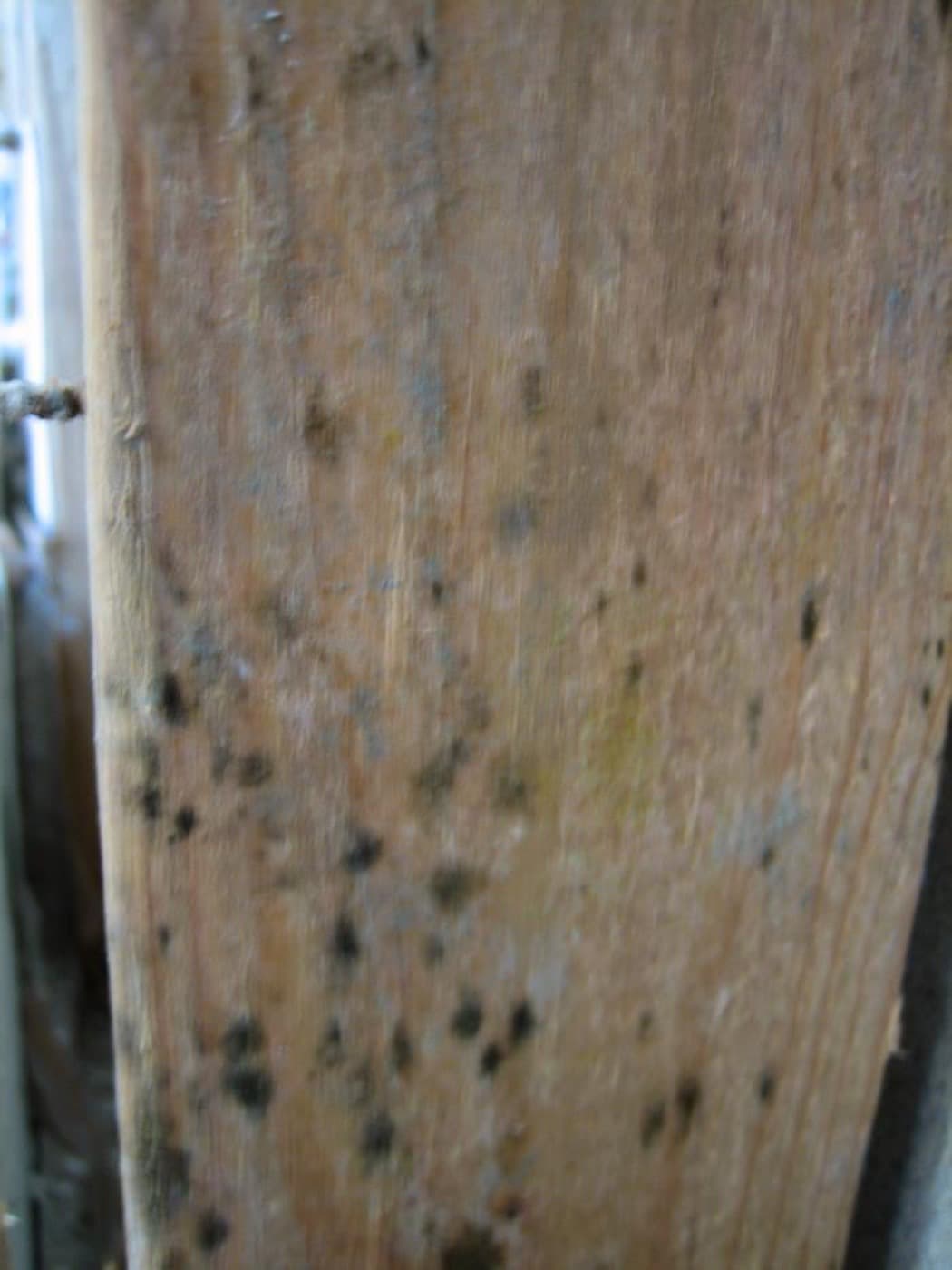
Wood is the semi-porous middle ground. Surface growth on a stud — the black speckling you find when drywall comes off — usually sits on the surface rather than in the grain, and it is cleaned rather than replaced: HEPA-vacuum to capture the dry spores, scrub with detergent and water, rinse lightly, and dry until a pin moisture meter reads the same as a dry stud elsewhere in the house. Then HEPA-vacuum again. What you must not do is close the wall over wood that is still wet; every hour it stays damp is an hour the growth you did not remove is spreading. Stained wood that is structurally sound can stay — the stain is dead pigment, not live growth — though many people prefer to sand and seal it. Wood that is soft, punky or crumbling has rot as well as mold and is a structural question for a carpenter. The details, including how to tell rot from stain, are in how to remove black mold from wood.
Concrete, block and masonry
Concrete is porous enough to hold moisture and rough enough to hold mold, but it does not rot, so it is almost always cleaned rather than replaced. Scrub with detergent and water using a stiff brush, rinse, and dry with fans. The treatment is straightforward; the difficulty is that mold on a basement or crawl-space wall is fed by moisture coming through the wall, and no surface product changes that. Grading, downspouts, gutters and — inside — a dehumidifier holding humidity under the CDC's 50% ceiling are the actual long-term treatment. My own basement's mold problem ended when a downspout was extended, not when the wall was scrubbed. Specifics for slabs, walls and painted concrete are in how to remove black mold from concrete.
Carpet, insulation, ceiling tiles, fabric, paper
These are the materials the EPA names or implies when it says porous items "may have to be thrown away." There is no effective surface treatment for mold that has grown into carpet pad, batt insulation or acoustic tile; the growth is inside, the material stays damp, and spraying the top only wets it further. Bag and replace. Washable fabric is the one exception — a hot wash with detergent removes surface growth from clothing, towels and curtains, and the CDC's advice to remove or replace soaked carpets and upholstery that cannot be dried right away is the rule for everything else. Paper and books are discarded unless irreplaceable, in which case freezing stops growth until a conservator can assess them.
HVAC ducts and air handlers
Do not treat these yourself, and do not run the system. The EPA is categorical: "Do not run the HVAC system if you know or suspect that it is contaminated with mold — it could spread mold throughout the building." Duct cleaning and coil treatment are professional jobs with their own equipment; HomeGuide's February 2026 survey puts HVAC and duct remediation at $2,000 to $10,000 and This Old House's March 2026 figures at $3,000 to $10,000. What you can do is turn the system off, tape over the registers in the affected room, and get an assessment before anyone sells you a duct-fogging service. Black mold in air vents covers how to tell duct mold from dust and what an assessment should include.
What the evidence says about the chemicals
People ask about products before they ask about surfaces, so here is what the register of sources actually shows, chemical by chemical.
- Bleach (sodium hypochlorite). Effective at killing spores on hard surfaces — the 2015 review cites a study in which 2.4% sodium hypochlorite inactivated spores of Stachybotrys chartarum and five other molds to undetectable levels after 5 minutes on non-porous surfaces and 10 minutes on porous ones. But the EPA states that "the use of a chemical or biocide that kills organisms such as mold (chlorine bleach, for example) is not recommended as a routine practice during mold cleanup," because dead mold still has to be physically removed and because of the fumes. The CDC's ceiling is 1 cup per gallon. Full discussion in does bleach kill black mold.
- Vinegar (4–4.2% acetic acid). In the same 2015 study's own experiment, household vinegar inhibited Penicillium chrysogenum but "did not show an inhibitory effect on the growth of Aspergillus fumigatus." The authors' verdict: "vinegar has limited antifungal action" and "may not be effective against the diverse fungal genera found in the indoor air environment." Fine as a mild cleaner on a hard surface; not a treatment you should rely on.
- Rubbing alcohol (70% ethanol). The same test found it "had no visible effect on the growth of either fungi." Cross it off.
- Hydrogen peroxide. Inhibited growth on pine blocks in the cited wood-block study, then failed the rinse-and-wait test like every other agent. Useful on hard surfaces; not a cure for porous ones. See hydrogen peroxide for black mold.
- Tea tree oil. The most effective agent in the 2015 study against both test molds — and the authors note its constituents may sensitise skin and that inhalation effects are not well studied. Interesting; not something I would fog a bedroom with.
- Borax. Not tested in any source in this site's register; the practical case is in will borax kill black mold.
The pattern across all of them is the same: a chemical can kill or inhibit what it touches on a hard surface, and none of them substitutes for removing porous material or fixing moisture.
"Treatments" that are really cover-ups
Three things get sold as black mold treatment that the sources do not support. Painting or priming over growth — the EPA: "Do not paint or caulk moldy surfaces. Clean up the mold and dry the surfaces before painting." Fogging or ozone "whole-room" treatments — the EPA's position is that "it is impossible to get rid of all mold and mold spores indoors," and a fog does not remove the growth or the moisture that fed it. And encapsulating coatings applied over untreated growth — the S520 standard has a chapter on antimicrobial chemicals and coatings, but coatings belong on cleaned, dried surfaces as a finishing step, not as a substitute for removing growth. If a contractor's entire proposal is a spray, ask what happens to the drywall.
Treating the room, not just the surface
Every surface treatment above is temporary if the room stays hospitable. The CDC's prevention list is short and it is the real treatment plan: keep humidity "no higher than 50% — all day long" with air conditioning or a dehumidifier; vent bathroom and kitchen exhaust fans and the clothes dryer to the outside; fix leaks in roof, walls and plumbing; dry anything wet within 24 to 48 hours; add mold inhibitors to paint; and keep carpet out of bathrooms and basements. The EPA's version is one sentence — "if you clean up the mold, but don't fix the water problem, then, most likely, the mold problem will come back" — and it is the sentence I would put on the label of every mold product sold.
If the growth you are treating is over about 10 square feet, involves sewage or flood water, or is in the HVAC system, the EPA's guidance is to bring in a contractor; the full protocol is in black mold cleanup and what a professional job involves is in black mold remediation. For everything smaller, this page and the parent guide, how to remove black mold, are enough — and you can always come back to the Black Mold Removal Hub homepage for the cost estimator when a surface turns out to be a wall.
Get a realistic price before you call anyone
Use our free Black Mold Removal Cost Estimator to get a tailored price range for your room, size, and severity — built from current national and regional pricing data. Then you'll know whether a contractor quote is fair before you commit.
Open the Cost Estimator →Sources
- U.S. EPA — A Brief Guide to Mold, Moisture and Your Home (read September 2026)
- U.S. EPA — Mold Cleanup in Your Home (read September 2026)
- CDC — Mold: About (read September 2026)
- Rogawansamy S, Gaskin S, Taylor M, Pisaniello D. An Evaluation of Antifungal Agents for the Treatment of Fungal Contamination in Indoor Air Environments. Int J Environ Res Public Health 2015;12(6):6319
- IICRC — ANSI/IICRC S520 Standard for Professional Mold Remediation, 4th ed. (2024)
- HomeGuide — Mold Removal Cost (February 2026)
- This Old House — Mold Remediation Cost (March 2026)