Black Mold Exposure Treatment at Home: What Helps, What Doesn't

Quick answer
Two steps make up black mold exposure treatment at home: end the exposure, then ease mild symptoms with measures such as a saline nasal rinse, an over-the-counter antihistamine or a HEPA air purifier. No home remedy removes mold or its byproducts from your body, and mold detox products lack good clinical evidence. See a doctor if symptoms persist, recur or worsen, especially with asthma or a weakened immune system.
Home treatment for mold exposure means what you can do yourself: end the exposure, cut down what you breathe, and ease mild symptoms while the mold is removed. Black mold exposure treatment at home also starts with an honest statement that a lot of pages on this topic avoid: there is no home remedy that removes mold or its byproducts from your body, and anyone selling you a mold detox protocol is selling something the evidence does not support.
What you can genuinely do at home is meaningful, though — end the exposure, reduce what you are breathing, ease mild symptoms, and recognise clearly when something needs a doctor rather than a home approach. That is what this page covers.
This is general information, not medical advice. If you are unwell, speak to a healthcare professional — particularly if you have asthma, a weakened immune system, or a chronic lung condition.
What does mold exposure actually do to the body?
It helps to be clear about the mechanism, because the internet contains a great deal of alarming material that is not well supported.
Most reactions to indoor mold are allergic or irritant responses. Spores and fragments in the air irritate the airways and, in sensitised people, provoke an allergic reaction. That produces the familiar cluster: congestion, sneezing, runny nose, itchy or watery eyes, coughing, wheezing, throat irritation, sometimes skin irritation or a rash. People with asthma may find their asthma worsens. The EPA's Brief Guide to Mold, Moisture and Your Home (read November 2026) says, "Allergic reactions to mold are common. They can be immediate or delayed," and that "Symptoms other than the allergic and irritant types are not commonly reported as a result of inhaling mold."
Certain molds also produce mycotoxins, and this is where public discussion becomes overheated. Mycotoxins are genuinely toxic in agricultural contexts — contaminated grain consumed in quantity — but the evidence that inhaling them at typical indoor levels causes the wide range of conditions attributed to "toxic mold syndrome" is weak. The CDC is measured on this point. Its fact sheet on Stachybotrys chartarum says a link between that mold and acute idiopathic pulmonary hemorrhage in infants "has not been proven," and that "At present, no test exists that proves an association between Stachybotrys chartarum and particular health symptoms."
What this means practically: mold in your home is worth removing promptly, and symptoms are worth taking seriously — but a damp patch on a wall is not usually a medical emergency, and treating it as one leads people toward expensive interventions that do not help.
Some groups do face genuinely higher risk and should be more cautious. The CDC names people with asthma or mold allergy (more severe reactions) and people with weakened immune systems or chronic lung disease (lung infections). The AAP's HealthyChildren.org page on aspergillosis says the allergic form "occurs most often in children with chronic asthma or cystic fibrosis." For those groups, professional removal rather than DIY is the sensible default. Our page on whether black mold is dangerous covers the risk picture in more detail, and black mold symptoms goes through the symptom list.
Step one, and it isn't a remedy: end the exposure
Nothing you do for symptoms matters much while you are still breathing the source. This is the single most effective intervention available and it is free.
- Stay out of the affected room as much as practical, and keep its door closed so air is not exchanging with the rest of the house.
- Ventilate. Open windows in the affected space and put a fan in one blowing outward, so air is being pushed out rather than circulated inward.
- Turn off central heating and air conditioning if growth is anywhere near ducting or the system's return, because otherwise you are distributing spores through the whole house.
- Do not disturb the growth without protection. Dry-brushing or scraping mold puts far more into the air than leaving it alone does. If you cannot deal with it properly yet, leaving it untouched is better than a half-hearted attack.
- Move sleeping arrangements if the affected room is a bedroom. Eight hours a night in a mouldy room is the largest single block of exposure most people have.
- Wash clothing and bedding that has been in the affected space.
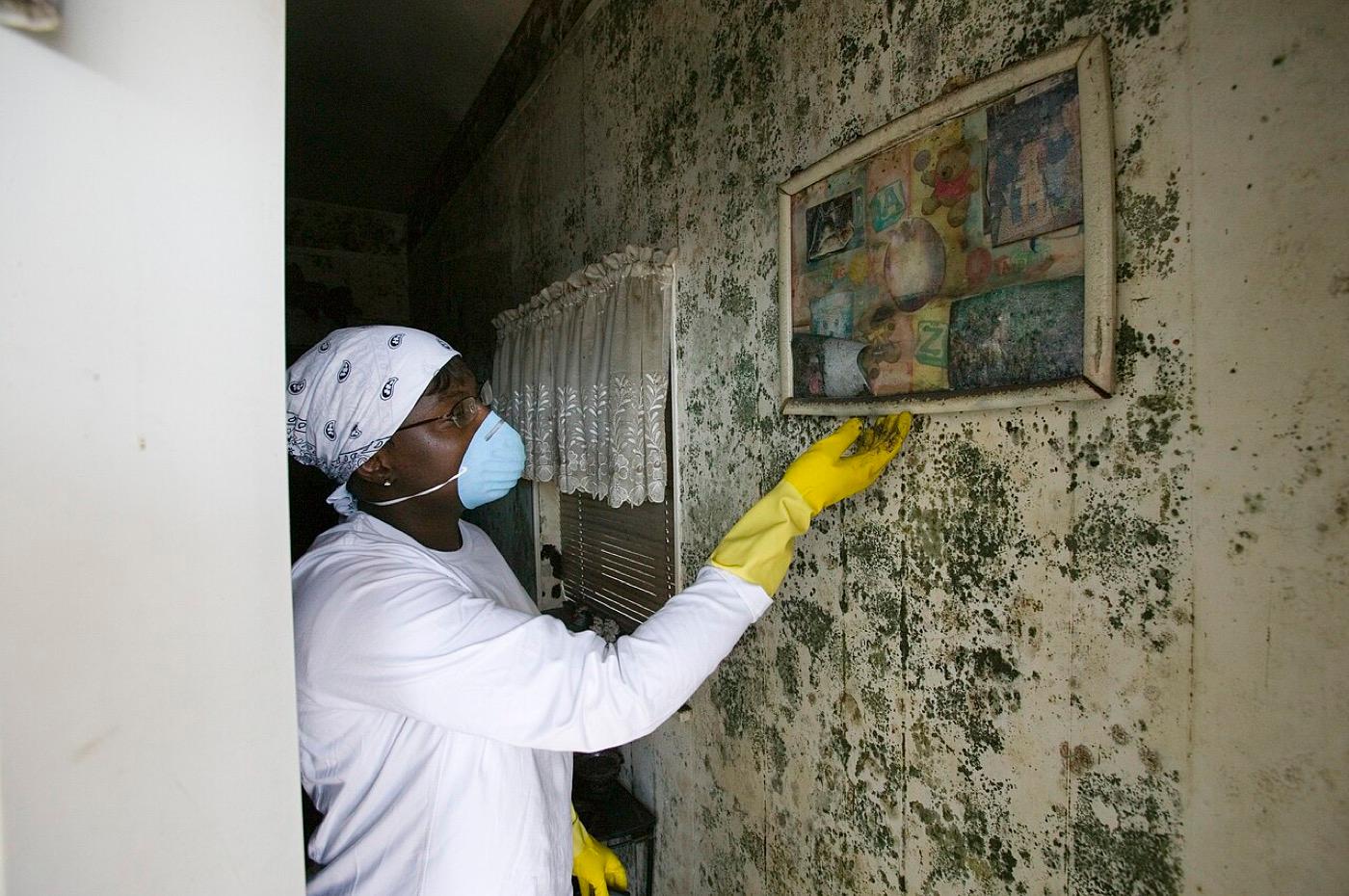
If you are going to do the removal yourself, wear an N95 respirator, gloves and sealed eye protection, and follow the containment steps in our guide to getting rid of black mold. If the affected area exceeds roughly ten square feet, involves sewage or floodwater, or reaches your HVAC system, the EPA's guidance points toward professional remediation — and if you are already symptomatic, that recommendation gets stronger, because you would be the person in the room while spores are airborne.
Measures that genuinely help with mild symptoms
For mild allergic-type symptoms in an otherwise healthy adult, ordinary supportive measures are reasonable and are essentially the same things you would do for any airborne allergen.
- Saline nasal rinse or spray. Physically flushes irritants from the nasal passages and is one of the few genuinely mechanical interventions available. Use distilled, sterile or previously boiled and cooled water — not water straight from the tap.
- Over-the-counter antihistamines can reduce allergic symptoms. A pharmacist can advise on which suits you and what interacts with anything else you take.
- Steam or humidified air can ease throat and airway irritation, though be careful not to raise humidity in a house that already has a mold problem — do it in a bathroom with the extractor running.
- Hydration and rest, which sound like filler advice but genuinely help the body clear irritants and recover.
- A HEPA air purifier in the room you spend most time in reduces the airborne spore concentration you are breathing. It does not prevent growth and it is not a substitute for removal, but for symptom relief while remediation is pending it is worthwhile. See choosing an air purifier for mold.
- Shower and change clothes after any time spent in the affected space, particularly before sleeping.
The honest framing is that these measures manage symptoms while the actual fix — removing the mold and the moisture behind it — proceeds. They are not treatments for mold exposure. They are relief for irritated airways.
The remedies that don't do what they claim
Search results for this topic are full of protocols promising to detox mold from your body. It is worth being direct about them, because some are expensive and a few carry real risk.
"Mold detox" supplement protocols — typically binders such as activated charcoal or bentonite clay, sold alongside a long supplement list. There is no good clinical evidence that these remove inhaled mold or mycotoxins from the body. Activated charcoal also binds medications in the gut, which can reduce the effectiveness of prescriptions you actually need.
Ingesting anything antifungal that is not a prescribed medication — colloidal silver, high-dose oregano oil, various "internal cleanses." Colloidal silver in particular: NIH's National Center for Complementary and Integrative Health says silver "has no known functions or benefits in the body when taken by mouth" and that it can cause argyria, "a bluish-gray discoloration of the skin" that is usually permanent (NCCIH, read November 2026).
Essential oils taken internally. Tea tree oil was the most effective agent in one 2015 lab test of surface antifungals (Rogawansamy et al.). That was on lab dishes, not in people. NCCIH: "Tea tree oil should not be swallowed"; taken orally it "can cause serious symptoms such as confusion, unsteadiness, inability to walk, and coma."
Extreme sauna, fasting or juice protocols marketed as mold detoxification. None of the sources on this page supports them for this purpose; check with a doctor first, especially with an underlying condition.
Broad mycotoxin blood or urine testing marketed direct to consumers. Interpretation is contested, reference ranges are poorly established, and results frequently lead to costly treatment for conditions that have not been demonstrated. If testing is warranted, that is a decision for your doctor.
The reason to be blunt about this: money spent on detox protocols is money not spent on remediation, and remediation is the intervention that actually changes your exposure. If you are choosing between a supplement stack and fixing the leak, fix the leak.
When should you see a doctor about mold exposure?
Home measures are appropriate for mild, clearly allergic symptoms in a healthy adult that are mild and tied to a place the person can avoid. Outside that, see a healthcare professional.
Seek urgent medical attention for difficulty breathing or shortness of breath at rest, chest pain or tightness, wheezing that does not respond to a usual reliever inhaler, coughing up blood, or a high fever with breathlessness.
Make a routine appointment (the CDC's Stachybotrys fact sheet says "Individuals with persistent symptoms should see their physician") if symptoms persist after exposure has ended, if they keep recurring, if asthma has worsened or needs more reliever than usual, if you develop a persistent cough or new wheeze, if you have recurring sinus infections, or if you have any unexplained symptom you are attributing to mold — because it may well be something else that deserves proper investigation.
Speak to a doctor promptly regardless of severity if you have a weakened immune system, are receiving chemotherapy or immunosuppressive treatment, have cystic fibrosis or COPD, or are pregnant. For pregnancy specifically, the general advice is not to carry out mold removal yourself at all — our page on black mold during pregnancy covers this, and consulting your doctor or midwife is the right first step.
When you do see someone, bring specifics: where the mold is, how large the area is, how long you have been exposed, when symptoms started, whether they improve when you are away from home, and any photographs you have. That last detail — whether symptoms ease when you spend time elsewhere — is one of the most useful pieces of information you can offer, and it is exactly the sort of thing people forget to mention.
Removal, not treatment, is the permanent fix
It is worth ending where the actual solution lies, because symptom management can become a substitute for solving the problem.
As long as the growth is present and the moisture feeding it continues, exposure continues, and no amount of antihistamine changes that. The sequence that resolves it is unglamorous:
- Find the water source.
- Stop it.
- Remove the affected material.
- Dry the structure thoroughly.
- Keep indoor humidity at 50% or lower, the CDC's recommendation, so it does not re-establish.
Our guide to what causes black mold works through the moisture sources in order of how often each turns out to be responsible, and preventing black mold covers keeping it gone afterwards. If the job is larger than a weekend, the cost guide and estimator will give you a realistic figure to judge contractor quotes against.
If you rent, this is your landlord's problem to fix in most jurisdictions. Report it in writing rather than by phone, keep the reply, and photograph everything before any work happens — see renters' rights around black mold.
What does it mean if symptoms improve away from home?
That's one of the most useful observations you can make, and it strongly suggests something in the building environment is responsible — though not necessarily mold specifically, since dust mites, pets, VOCs from new furnishings and gas appliances produce similar patterns. Mention it explicitly to your doctor, because it meaningfully narrows the investigation.
Are children more affected by black mold than adults?
Children with asthma are the clearest higher-risk group. The AAP's HealthyChildren.org lists mold spores among the most common allergens in children and says "Many children with asthma can develop worse symptoms if they are exposed to certain triggers," mold among them. The CDC notes a "potential link of early mold exposure to development of asthma in some children, particularly among children who may be genetically susceptible." If children live in the home, prioritise remediation and keep them out of affected rooms during any removal work.
Can pets be affected by black mold exposure too?
Yes. Animals can develop respiratory symptoms, and because they spend time at floor level and groom themselves, their exposure route differs from ours. Signs worth a vet visit include persistent coughing, sneezing, nasal discharge, lethargy or unusual scratching. Our page on black mold and dogs covers this in more detail.
Should you move out of the home while mold is being removed?
For a small area being cleaned properly with containment, usually not. For extensive remediation involving demolition, or if anyone in the household is in a higher-risk group — asthma, immune suppression, pregnancy, infants — temporary relocation is often sensible, and remediation contractors will advise on it as part of the scope. Ask them directly rather than assuming either way.
Free tools: decide what to do about your mold
Frequently asked questions
Is there any way to detox black mold from your body at home?
How long do black mold symptoms take to go away after exposure ends?
Can I take activated charcoal for mold exposure?
Does an air purifier help with mold exposure symptoms?
Should I get a mycotoxin test if I think I've been exposed?
Can black mold exposure cause long-term health problems?
Is it safe to sleep in a room with black mold?
Do I need antibiotics after black mold exposure?
Sources
- CDC — About Mold
- U.S. EPA — Mold Cleanup in Your Home
- U.S. EPA — Mold Resources
- U.S. EPA — A Brief Guide to Mold, Moisture and Your Home
- CDC — Facts About Stachybotrys chartarum
- AAP / HealthyChildren.org — Allergies in Children
- AAP / HealthyChildren.org — Aspergillosis
- NIH NCCIH — Colloidal Silver
- NIH NCCIH — Tea Tree Oil