Black Fuzzy Mold on Wall: What the Fuzz Actually Means

Black fuzzy mold on wall surfaces is telling you something specific, and it's worth understanding before you grab a spray bottle. That three-dimensional, slightly hairy texture is not a cosmetic detail — it is the mold's fruiting structure, the part that produces and releases spores. A stain lies flat. Fuzz stands up.
That distinction matters more than most homeowners realise. Flat black marks on a wall are often not mold at all, and the ones that are can frequently be wiped away. Fuzz means the colony has been growing long enough, and wet enough, to mature. It also means disturbing it carelessly will put spores into the air you are standing in.
From Sukie's experience
The first time I saw genuinely fuzzy mold it was behind our bathroom tub surround, and what struck me was that it looked almost soft — like grey-black velvet growing sideways out of the drywall paper. I had been scrubbing flat grey marks on the outside of that same wall for months, thinking I was winning.
Why fuzzy means mature, and why that changes your approach
Mold grows in two visible stages. First comes the mycelium — a network of fine filaments spreading across and into the surface. At this stage growth often looks like a flat stain or a faint discolouration, and many homeowners never register it as biological at all. Then, once the colony is established and moisture keeps coming, it produces spore-bearing structures that lift away from the surface. That is the fuzz.
So when you are looking at black fuzzy growth, you are looking at a colony that has had a sustained water supply for a while. Not a splash. Not last week's steamy shower. Something has been feeding it — a slow leak, a cold surface that condenses every night, ground water wicking through masonry.
This has a practical consequence. Because fuzzy growth is actively producing spores, physically disturbing it — scrubbing, scraping, or even brushing past it — releases them into the room. The EPA's mold cleanup guidance is explicit that protective equipment and containment matter more as the affected area grows. Fuzz is a signal to slow down and prepare, not to attack immediately.
It also tells you something about what is behind the wall. Surface condensation tends to produce flatter, more speckled growth spread over a wide area. Dense fuzzy patches concentrated in one spot usually point to a localised water source — and that source is often on the other side of the drywall.
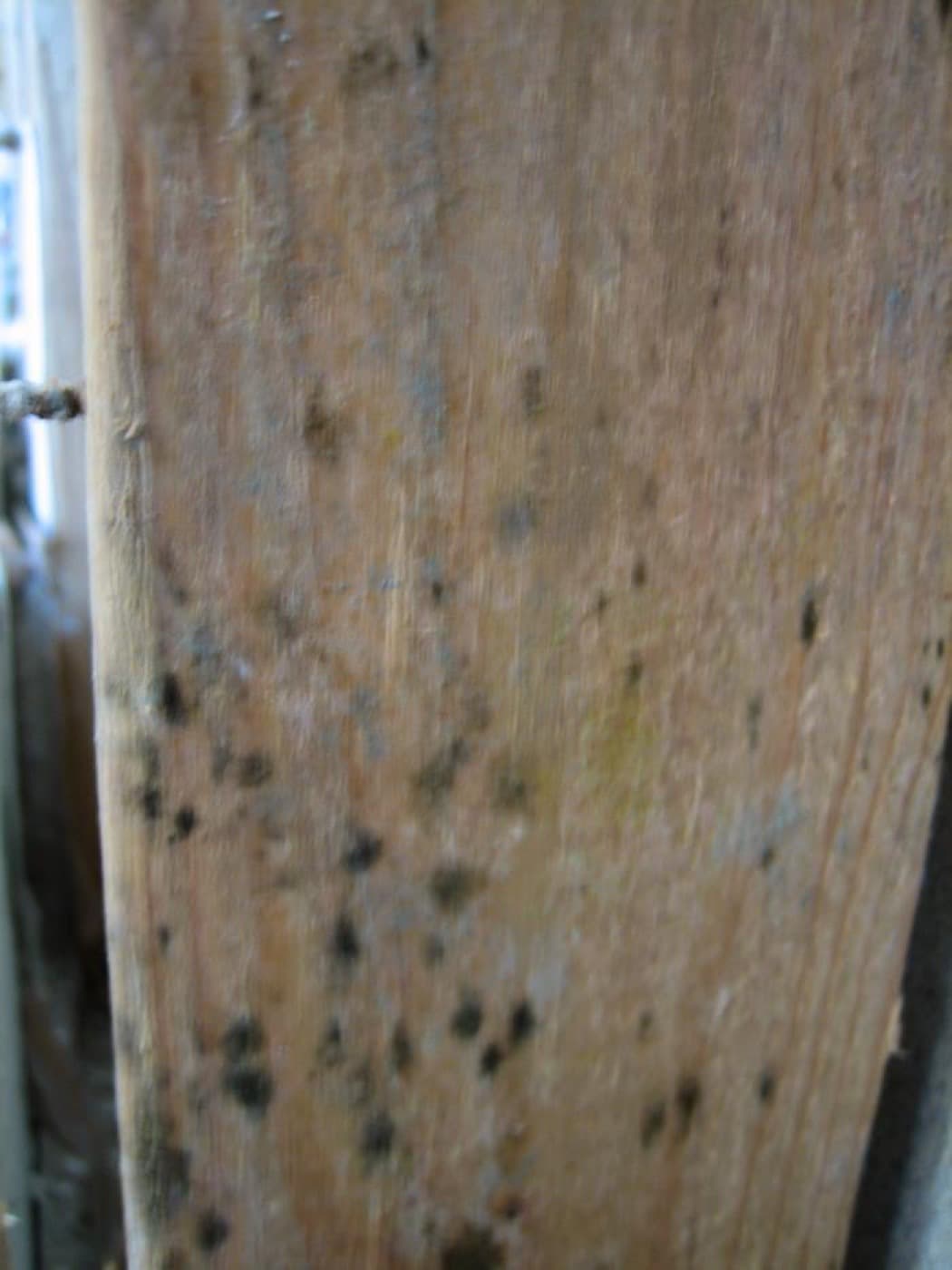
Fuzzy mold, flat mildew, soot, and the things people confuse them with
Before you plan a removal, be reasonably confident about what you're looking at. Several common wall marks get mistaken for mold, and a few of them need completely different fixes.
Mildew is technically a mold, but the growth people call mildew is typically flat, powdery and grey-to-white, sitting entirely on the surface. It wipes off with a damp cloth and takes the colour with it. Fuzzy black growth does not — wipe it and you smear it, and the underlying surface stays discoloured.
Soot and smoke residue from candles, a fireplace or a gas appliance produces flat black deposits, often heaviest above heat sources or in a ghosting pattern that traces the studs behind the drywall. Soot smears greasily and has no texture standing off the wall. If your black marks form neat vertical stripes matching stud spacing, you are almost certainly looking at thermal ghosting, not mold.
Dirt around air movement collects on wall surfaces near vents, door gaps and along the top of skirting. It is flat, evenly distributed and cleans off completely.
Cobweb-adjacent dust build-up in corners can look fuzzy at a glance but is grey, dry, and lifts away as a whole rather than staying anchored.
The reliable tests are texture and permanence. Real fuzzy mold has visible relief when you look at it from a low angle with a torch, and it does not fully clean away with a damp cloth. If you are still unsure after that, our guide on telling black mold from mildew goes through the comparison in more depth.
Not sure if it's a DIY job or a pro job?
Get a ballpark price first, then decide.
Estimate my removal cost →What the colour and pattern are actually telling you
Homeowners often want to know whether black fuzz specifically means Stachybotrys chartarum, the species that gets called toxic black mold. Honestly: you cannot tell by looking, and neither can anyone else without a lab. Dozens of mold species appear black or near-black on a wall, and colour varies with the surface, the light and the age of the colony.
The CDC's position is worth internalising here, because it saves a lot of anxiety and money. Their guidance on mold notes that identifying the specific species generally does not change what you should do about it. Any significant indoor mold growth should be removed and the moisture behind it fixed, regardless of what it turns out to be.
Pattern, however, is genuinely informative:
- A concentrated patch with a defined edge — a specific water source close by. Look directly behind or above it.
- Growth following a horizontal line — a historic water level, or the top of a wet zone wicking up from below.
- Growth in a corner, worst at the top — a cold spot where warm humid air condenses. Common on exterior-facing corners in winter.
- Speckling spread thinly across a whole wall — room-wide humidity rather than a leak.
- Vertical streaks from the ceiling down — water arriving from above, often a roof or plumbing issue.
Read the shape before you clean it, because cleaning destroys the evidence. I would take photographs first — they are genuinely useful if you later need to show a contractor, a landlord or an insurer.
Find the water first — the part people skip
There is no version of this job where you remove the mold and skip the moisture. Kill a colony, leave the leak, and you will be looking at the same patch within weeks. Mold needs moisture, a food source and time; drywall paper, wood and dust supply the food, and you cannot remove those from a house. Moisture is the only variable you actually control.
Work through the likely sources in order of how commonly they turn out to be the culprit:
- Plumbing on the other side of the wall. Bathrooms, kitchens and laundry rooms back onto each other constantly. A supply line weeping a few drops an hour is enough.
- A shower or tub enclosure with failed sealant. Water tracks behind tile and into the wall cavity while the visible surface looks fine.
- Roof or gutter failure if the growth is high on the wall or near the ceiling.
- Condensation on a cold surface. Exterior walls, uninsulated corners and behind furniture pushed flat against an outside wall.
- Ground moisture if the wall is below grade — see our guide to basement mold for how this behaves differently.
- A one-off event you have half-forgotten — an overflowed bath, a burst appliance hose, a window left open in a storm.
A cheap moisture meter — around $20 to $40 — is genuinely worth buying before you start. Press it against the wall in a grid pattern outward from the growth. Elevated readings extending well past the visible mold tell you the wet zone is larger than the stain, which is common and which changes how much material you need to remove.
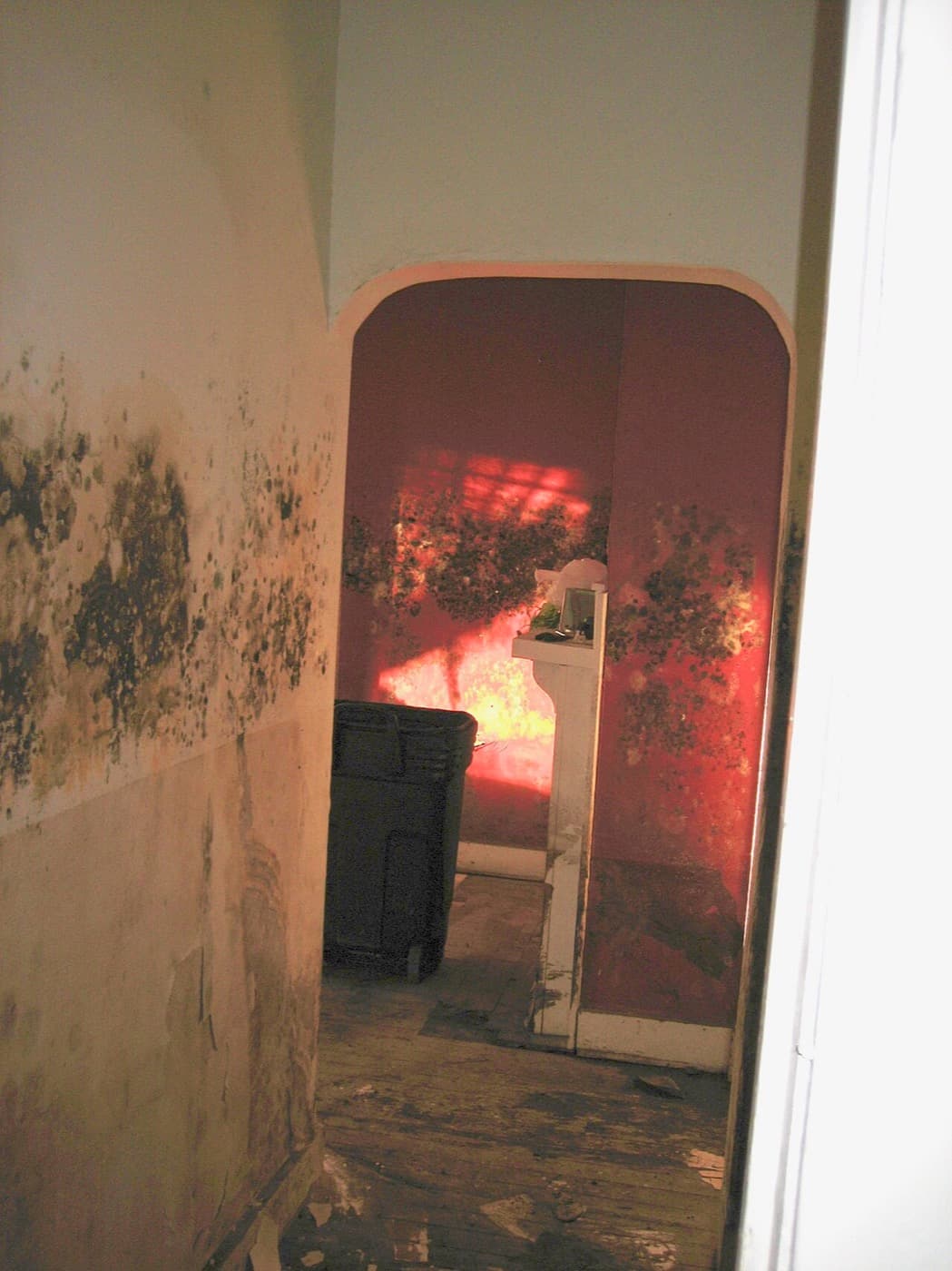
Removing it without spreading spores through the house
Assuming you have found and stopped the water, and the affected area is smaller than roughly ten square feet, this is usually a homeowner job. Bigger than that, or if it involves sewage, flooding or your HVAC system, hand it to a certified remediation contractor.
Gear first, and do not compromise here: an N95 respirator at minimum, rubber gloves that come up the forearm, and eye protection without ventilation holes. Fuzzy growth aerosolises readily.
The single biggest mistake I see described online is dry-brushing fuzzy mold off a wall. It looks satisfying and it fills the room with spores. Always mist the surface first.
The sequence that works:
- Isolate the room. Close interior doors, tape plastic sheeting over doorways if the patch is substantial, and switch off central heating or air conditioning so the system does not distribute spores.
- Ventilate outward. Open a window in the affected room and put a fan in it blowing out, not in.
- Mist, don't dry-brush. Lightly spray the growth with your cleaning solution and let it sit. Damp spores stay put.
- Clean. Detergent and water genuinely works on hard, non-porous surfaces; the EPA does not consider bleach necessary for routine mold cleanup. On painted drywall, a mold-specific cleaner or a hydrogen-peroxide-based product is a reasonable choice.
- Assess the substrate. This is the decision point. If the drywall is soft, crumbling, stained through, or your moisture meter says it is still wet inside, cleaning the face achieves nothing. That section needs cutting out.
- Dry hard. Fans and a dehumidifier for several days. Aim to get relative humidity under 50%.
- Dispose carefully. Bag cleaning materials and any removed drywall in the room, seal the bag, and carry it straight outside rather than through the house.
For step-by-step detail on the drywall-cutting scenario, see removing black mold from drywall.
When fuzzy growth means calling someone
I am generally in favour of homeowners doing their own small remediation work. It is not mysterious and the products are all available. But there are situations where the maths stops favouring DIY, and fuzzy black growth crosses into several of them more often than flat surface mold does.
Call a professional if any of these apply:
- The affected area is larger than about ten square feet — roughly a three-by-three-foot patch.
- You cut into the wall and found growth on the framing or spreading through the cavity.
- The moisture source is inside the structure and you cannot access it.
- Mold is in or near your HVAC ducting, where the system will distribute it.
- The water involved was sewage or floodwater.
- Anyone in the household has asthma, a compromised immune system, or an existing respiratory condition.
- You have cleaned the same spot more than once and it keeps returning — that means the real source is still active.
If you want a sense of what that costs before you make a call, our black mold removal cost guide covers typical pricing, and the cost estimator will give you a range for your specific room and severity. Knowing a fair number beforehand is the difference between a fair quote and an expensive one.
Get a realistic price before you call anyone
Use our free Black Mold Removal Cost Estimator to get a tailored price range for your room, size, and severity — built from current national and regional pricing data. Then you'll know whether a contractor quote is fair before you commit.
Open the Cost Estimator →