Roof Leak and Mold: What to Do, in Order, to Stop It Becoming a Mold Job

Quick answer
Stop the water first with a tarp or temporary patch, photograph the damage before removing anything, then dry everything you can within 24 to 48 hours. EPA says wet ceiling tiles and insulation should be discarded, and ceiling drywall can stay only if it is not swollen and its seams are intact. Clean small growth yourself; hire a pro past about 10 square feet. Insurance usually depends on whether the leak was sudden or gradual wear.
Is the water stain spreading across your ceiling already a mold problem, or is there still time to stop one? With a roof leak and mold, the order of the next two days decides most of the outcome. The U.S. EPA says that if wet or damp materials are dried within 24 to 48 hours after a leak, in most cases mold will not grow. The sequence: stop the water and photograph it, sort each wet material into dry-it or discard-it, decide whether the ceiling and insulation come down, then call the right people in the right order. If you already see growth, the same steps apply, with one change: anything past about 10 square feet becomes a job for a professional.
1. Stop the water, then photograph everything before you remove it
Stop more water arriving first. EPA's rule, in its Brief Guide to Mold, Moisture and Your Home: if you clean up the mold but do not fix the water problem, the mold problem will most likely come back. The Texas Department of Insurance's homeowners guide (last updated June 2026) says to make only temporary repairs, such as a tarp over a damaged roof, and not to make permanent repairs before the insurance company sees the damage, because it might deny the claim if you do.
Inside, catch the drips and move books, papers, rugs and upholstered furniture out of the wet room. Before you remove anything, take pictures or videos of the damage, list damaged property and keep receipts, as TDI advises. For a roof leak, photograph the roof from the ground (do not climb a wet roof), the attic above the stain, the stain with something for scale, and each damaged item, and note the date and the weather, because sudden storm versus slow wear is the question your insurer will ask (section 4).
Two cautions. EPA's drying table is written for clean water; if the water has run through something contaminated, EPA says protective equipment and containment are required and warns not to use fans before you have established that the water is clean or sanitary. And if you suspect the heating and cooling system is contaminated with mold, EPA says not to run it.
2. Dry it or throw it out: the first 48 hours, material by material
Table 1 of EPA's remediation guide is the most useful single document for a roof leak, because it was written for exactly this moment: water damage that has not yet grown mold. EPA describes it as strategies to respond to water damage within 24 to 48 hours, before growth starts, and notes that professional help may be needed to dry a large area quickly and thoroughly.
| Step (first 48 hours) | Why it matters | Source |
|---|---|---|
| Stop the water: tarp or temporary patch only | Mold returns if the water problem is not fixed; permanent repairs first can put a claim at risk | EPA Brief Guide; Texas Dept. of Insurance |
| Photograph and list the damage before removing anything | Pictures or videos before any repairs, a damage list, kept receipts | Texas Dept. of Insurance |
| Confirm the water is clean before running fans | Contaminated water requires PPE and containment | EPA remediation guide, Table 1 |
| Dry everything that can be dried, within 24–48 hours | Dried within 24–48 hours, in most cases mold will not grow | EPA Brief Guide; CDC |
| Discard wet ceiling tiles and wet cellulose or fiberglass insulation | Table 1 says: discard and replace | EPA remediation guide, Table 1 |
| Wet drywall: dry in place only if not swollen and seams intact | Otherwise remove, discard and replace | EPA remediation guide, Table 1 |
| Wood framing and decking: remove moisture immediately | Dehumidifiers, gentle heat and fans | EPA remediation guide, Table 1 |
| Still wet after 48 hours, or mold visible: switch to remediation | EPA sends you to its size-based Table 2 | EPA remediation guide, Tables 1–2 |
Source: U.S. EPA, Mold Remediation in Schools and Commercial Buildings, Table 1 (page updated September 2026) and A Brief Guide to Mold, Moisture and Your Home; CDC, Mold; Texas Department of Insurance, homeowners insurance guide. All read November 2026.
Read the footnotes as carefully as the rows. EPA says the 48-hour figure is only a guideline: even if materials are dried within 48 hours, mold growth may have occurred, and mold will not always occur after 48 hours either. The window is a planning tool, not a promise.
The table splits a roof-leak room into three groups. Discard: ceiling tiles, cellulose insulation and fiberglass insulation are all "discard and replace" in EPA's table, with no drying option offered. EPA's homeowner guide explains why: mold can fill the crevices of porous materials and be difficult or impossible to remove completely. Dry, then judge: drywall (EPA calls it wallboard), carpet and backing, and upholstered furniture, which EPA notes may be hard to dry within 48 hours. Dry and clean: wood, concrete and non-porous hard surfaces, damp-wiped with water and mild detergent.
An illustrative example: a storm pushes water past a lifted shingle, soaks a patch of attic insulation, and leaves a plate-sized stain on the bedroom ceiling. Following the table, the insulation is bagged and replaced, the decking and rafters are dried with fans and a dehumidifier, and the drywall is checked before anyone decides it can stay.
3. When ceiling drywall and insulation have to come out
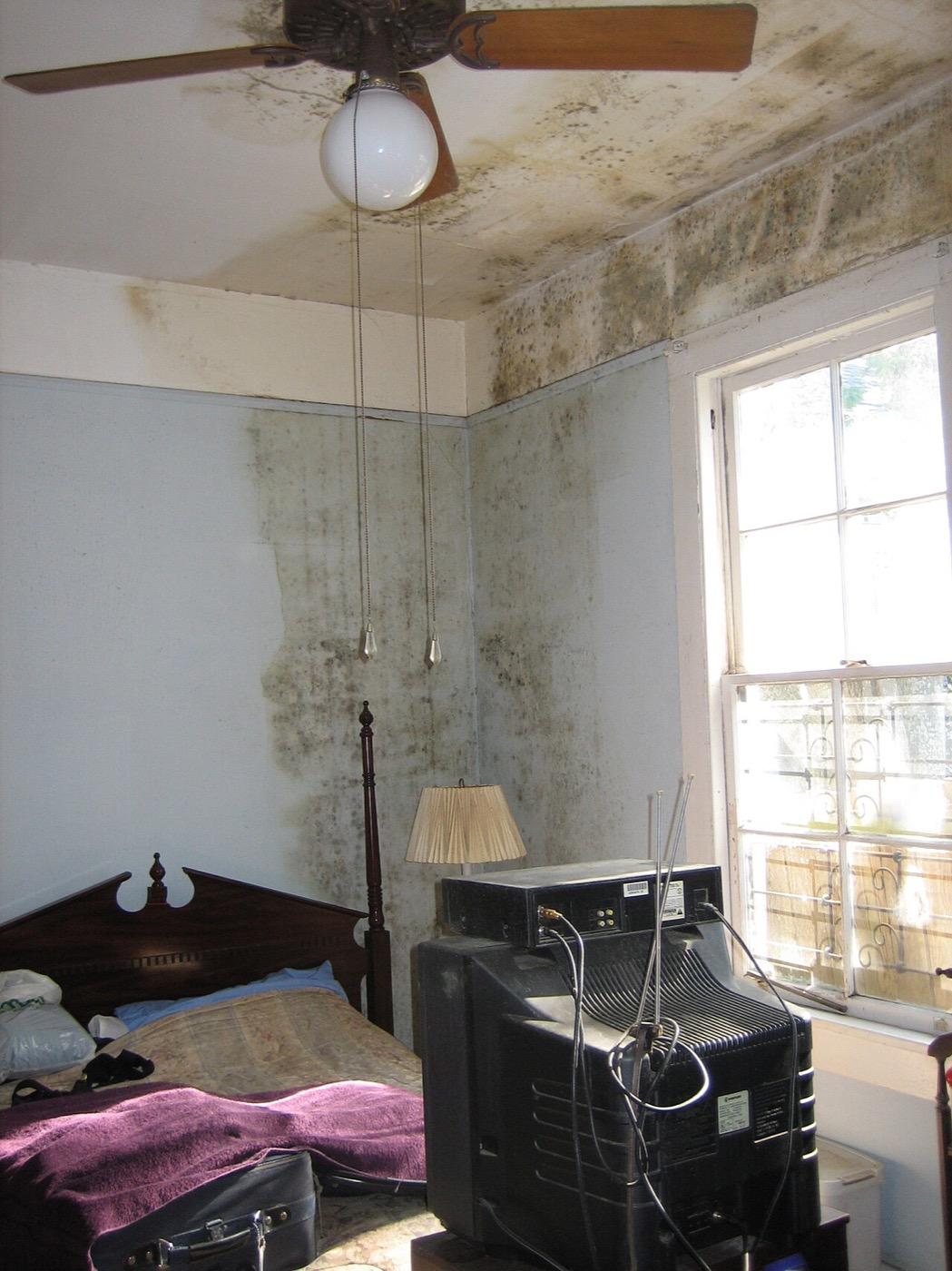
Ceiling drywall gets one sentence in EPA's table, and it is the whole decision: wallboard may be dried in place if there is no obvious swelling and the seams are intact; if not, remove, discard and replace it, and ventilate the cavity if possible. So check three things: is the panel sagging or soft, have the taped joints split, and is there visible growth? A yes to any means that piece comes down. A firm panel with intact seams can be dried and later painted, but never over mold: EPA says not to paint or caulk moldy surfaces. For the cutting and cleaning itself, see how to remove black mold from a ceiling.
Insulation is simpler: EPA gives no drying option for wet cellulose or fiberglass. Check the attic side before the ceiling is closed up, since the wet area above can be wider than the stain below. If the leak ran into the attic for a while, read black mold in the attic for how growth on roof sheathing and rafters is handled; water that tracked down an inside corner of a room is covered in mold in corners.
DIY or pro depends on size, not colour. EPA's line for homeowners is less than about 10 square feet, roughly a 3 ft by 3 ft patch; within that, wear an N-95 respirator, gloves and goggles without ventilation holes. Its remediation guide (Table 2) scales up from there: 10 to 100 square feet calls for limited or full protective equipment and limited containment (a single layer of 6-mil polyethylene, vents and doors sealed, a HEPA-filtered fan exhausting outside); more than 100 square feet calls for full equipment and full containment with a decontamination chamber. Overhead work makes this harder, since debris falls toward your face, and EPA advises consulting a health professional before starting cleanup if you have health concerns. Hire a professional for anything past about 10 square feet, for contaminated water, for mold inside ductwork, or if anyone in the home has asthma or a weakened immune system.
One thing you do not need is a mold test. EPA says that in most cases, if visible mold growth is present, sampling is unnecessary, and CDC does not recommend mold testing. The leak already shows where the water went.
4. Roofer, remediator or insurer: who to call, and in what order
A roof leak can need three different people. The roofer stops the water, and comes first. A remediator removes moldy material and is needed only when the growth is past what you can safely handle (about 10 square feet, per EPA) or is hidden in the roof cavity. EPA says to check the contractor's mold experience and references and ask them to follow EPA, ACGIH or IICRC guidelines. Some states license mold work and forbid the same company from both assessing and remediating a property; see who to call for black mold removal for which professional does what.
Your insurer is the call that depends most on how the leak happened. The Insurance Information Institute says mold is generally not covered by standard homeowners policies, treating it as a maintenance issue like rot; however, when mold growth is the direct result of a covered peril such as a burst pipe, the cost of eliminating it may be covered. For roofs, the California Department of Insurance's homeowners guide (Form 401, revised January 2026) lists windstorm or hail, falling objects, the weight of ice, snow or sleet, and sudden and accidental water damage among perils typically covered, and water damage caused by seepage or leaks, mold, wear and tear or maintenance, and neglect among perils generally not covered. The Texas Department of Insurance says most policies do not cover a continuous water leak or mold removal, except to repair damage caused by a covered risk.
So a storm that tore off shingles last night is a different claim from a worn roof that has dripped for a season, and your policy wording decides. The NAIC notes that many home policies exclude mold and that an endorsement (rider) can change coverage, so check for a mold endorsement before you call. Keep repairs temporary until the adjuster has seen the damage, and keep every receipt. Use the coverage checker on does insurance cover black mold removal.