Best Air Purifier for Mold: HEPA, CADR, and What Helps

Quick answer
For mold, choose a True HEPA filter, which EPA says can theoretically remove at least 99.97% of 0.3-micron particles, and size it with EPA's chart (a 200 sq ft room needs at least 130 cfm CADR). Carbon helps with musty smell. Avoid HEPA-type units and ozone generators. Run it for long stretches in the problem room, beside a dehumidifier if the room is damp. A purifier only captures airborne spores; it does not remove mold on surfaces or fix the moisture.
If you are shopping because one room smells musty or someone in the house keeps sneezing, know this up front: the best air purifier for mold is a phrase that promises more than any box on a shelf can deliver. An air purifier captures mold spores floating in the air, which can ease symptoms and reduce how many spores settle and colonize — but it does nothing about the mold already growing on your wall or the moisture feeding it. Used correctly, with a true HEPA filter sized to the room, it's a genuinely useful part of a mold strategy. Used as a substitute for fixing the source, it's an expensive air freshener.
Below is exactly what to look for, how to size it, and which models earn their keep.
What an air purifier can and can't do for mold
Set expectations first. An air purifier with a true HEPA filter captures airborne mold spores, which can lower the count of spores circulating in a room. That can reduce allergy-type symptoms for sensitive people and cut down on spores landing and starting new colonies. What it cannot do is kill or remove mold already growing on a surface, dry out a damp room, or fix a leak. The EPA emphasizes in its mold guidance that controlling moisture is the key to controlling mold — a purifier is a supporting player, never the cure.
Why does an air purifier for mold need true HEPA?
The filter type to look for is True HEPA. The EPA describes a HEPA filter as one that "can theoretically remove at least 99.97% of dust, pollen, mold, bacteria" and other airborne particles "with a size of 0.3 microns," and notes that 0.3 microns is the worst case: "Particles that are larger or smaller are trapped with even higher efficiency." Watch the wording: 'HEPA-type,' 'HEPA-like' or '99% at 2 microns' are marketing dodges that don't meet the real standard. An added activated-carbon filter is a nice bonus because it adsorbs the musty odor (those are gases HEPA can't trap), but it's the HEPA layer that does the spore work.
Be especially wary of two marketing tricks. The first is the phrase 'HEPA-type' or 'HEPA-style,' which sounds like the real thing but means the filter was never certified to the 99.97%-at-0.3-micron standard and may capture less. The second is a vague micron claim like '99% of particles as small as 2 microns' — that's a lower bar that lets a weaker filter sound impressive without meeting the HEPA definition. If the listing won't plainly say 'True HEPA' or 'HEPA H13,' assume it isn't, and move on. The certification is cheap to print when it's earned, so its absence is telling.
Reading CADR and matching it to your room
CADR (Clean Air Delivery Rate) is the number that cuts through marketing. The EPA puts it plainly: "The higher the CADR, the more particles the air cleaner can filter and the larger the area it can serve." Its Guide to Air Cleaners in the Home gives a minimum CADR for each room size:
| Room area (sq ft) | Minimum CADR (cfm) |
|---|---|
| 100 | 65 |
| 200 | 130 |
| 300 | 195 |
| 400 | 260 |
| 500 | 325 |
| 600 | 390 |
Source: U.S. EPA, Guide to Air Cleaners in the Home, updated Oct 2026, read Nov 2026. The chart assumes an 8-ft ceiling; EPA adds: "If you have high ceilings (above 8 feet), you should consider using an air cleaner that is sized for a larger area."
To use it, measure the room (length × width), find the next row up, and compare that figure with the CADR printed on the box or listing. A unit whose CADR sits above the minimum can run on a lower, quieter setting and still keep up. Each pick below is placed on this chart by its smoke CADR in the table "Our picks against EPA's sizing chart" further down. Smoke is used because it is the smallest of the three particle types AHAM tests (smoke, dust, pollen) and usually the lowest of the three numbers, so it is the conservative one.
Are ozone-generating 'purifiers' safe to use for mold?
Steer clear of any device that works by producing ozone. EPA's air-cleaner guide says to "Avoid portable air cleaners and furnace/HVAC filters that intentionally produce ozone," because "Ozone is a lung irritant," and adds that for ozone generators sold as air cleaners, "No federal government agency has approved these devices for use in occupied spaces." Ionizers are a gray area: EPA lists electrostatic precipitators, ionizers and some UV lights among air cleaners that "may have the potential to emit ozone." If a unit has an ionizer (like Winix's PlasmaWave), pick a model that lets you turn that feature off and rely on the HEPA filter alone.
How these air purifiers were picked
Every unit here uses a genuine True HEPA filter — that was a hard filter on the list. From there the picks are placed by their smoke CADR on EPA's chart, using the AHAM directory or the maker's own figure (table above). A commercial air scrubber is included for the specific case of active remediation, and gimmicky 'HEPA-type' and ozone-based gadgets that don't meet the standard are left out.
The list deliberately spans a range of room sizes and budgets rather than crowning one universal winner, because by EPA's chart a 600 sq ft open basement needs three times the CADR of a 200 sq ft bedroom (390 vs 130 cfm), and a big unit is overkill (and overpriced) for a small bathroom. The thread connecting all of them is genuine True HEPA filtration, sensible filter economics, and quiet-enough operation that you'll leave it running — which, for mold, is the whole point, since intermittent use does little. Match the pick's CADR to your actual room size and you'll get real value; buy on brand hype alone and you may end up with the wrong capacity for your space.
How each pick sizes up on EPA's chart
Most of the picks land on the same row of EPA's chart. Four of the six have a smoke CADR between 233 and 253 cfm, which clears the 195 cfm EPA lists for a 300 sq ft room but not the 260 cfm it lists for 400 sq ft. None of them is a whole-floor machine by EPA's sizing, whatever the box says about square footage.
| Product | Smoke CADR (cfm) | Largest room on EPA's chart | Source |
|---|---|---|---|
| LEVOIT Core 400S-P (LAP-C401S-WUSR) | 234 | 300 sq ft | AHAM Verifide directory |
| Coway Airmega AP-1512HH (Mighty) | 233 | 300 sq ft | Coway USA product page (cowaymega.com); the model is not in the current AHAM directory |
| Levoit Vital 200S-P (LAP-V201S-WUS) | 250 | 300 sq ft | AHAM Verifide directory |
| Levoit Core 300-P (model Core 300) | 143 | 200 sq ft | AHAM Verifide directory; Levoit's spec page also lists 143 CFM |
| AlorAir PureAiro HEPA Pro 770 air scrubber | Not published by the maker (AlorAir lists airflow of 270–550 CFM, which is not a CADR) | Cannot be placed on the chart | AlorAir product page |
| Winix 5510 | 253 | 300 sq ft | AHAM Verifide directory |
Sources: smoke CADRs from the AHAM Verifide room air cleaner directory (US listings), the Coway Airmega Mighty AP-1512HH product page, Levoit's Core 300-P spec page, and the AlorAir PureAiro HEPA Pro 770 page; room rows from the EPA Guide to Air Cleaners in the Home. All read November 2026. The room column is the largest EPA row whose minimum CADR is at or below the unit's smoke CADR, for an 8-ft ceiling.
Three things follow from the table. First, the "up to 1,718 ft²" and "up to 1,748 ft²" figures in the listings are one-air-change-per-hour claims; Coway's own page gives 361 sq ft for the Mighty at 4.8 air changes an hour, which is much closer to EPA's 300 sq ft row than to the headline.
For a room larger than 300 sq ft, or one with a ceiling above 8 ft, none of the room purifiers here meets EPA's minimum on its own. Either step up to a unit with a CADR of at least 260 cfm for 400 sq ft (390 cfm for 600 sq ft), or run two units in the space.
Where to place it and how to run it
Placement and habits decide whether the unit earns its price. Use this as a setup checklist:
- Put the purifier in the room with the problem, not a hallway, and keep doors closed so it's cleaning one space rather than the whole house.
- Give it clearance: EPA says "make sure the airflow is not obstructed" and to keep it "away from curtains and anything that might block airflow."
- Run it for long stretches rather than an hour a day: per EPA, "Increasing the amount of time an air cleaner runs will also increase air filtration." Use the auto mode if it has a sensor.
- Replace filters on schedule (EPA: manufacturers "typically recommend replacement every 60 to 90 days") — a clogged HEPA filter chokes airflow and a saturated carbon filter stops absorbing odors.
- In a damp room, pair it with a dehumidifier so you're attacking both the spores and the moisture.
- Clean the washable pre-filter if the model has one, so airflow stays strong and the unit does not get louder over time.
Using an air scrubber during active remediation
There's one scenario where air filtration really earns its keep: while you're actively disturbing mold. Cutting drywall or pulling baseboards aerosolizes a huge load of spores, and a HEPA air scrubber (negative-air machine) run during and after the work pulls that load out of the air before it settles all over the house. Pros use these as standard practice. For a DIY job at the edge of what's reasonable, a scrubber plus containment plastic and a respirator is a meaningful upgrade over hoping a small bedroom purifier keeps up.
An air purifier is part of a plan, not the plan
It bears repeating because it's the most important point: a purifier addresses airborne spores, not the source. The real mold fix is always the same sequence — find and stop the moisture, remove or clean the mold safely, dry the space, and keep humidity below 50%. The air purifier supports that by reducing circulating spores and easing symptoms, and it's worth running long-term in chronically damp rooms. Just don't let a clean-air readout convince you the wall behind the drywall is fine.
This is exactly where people get fooled. A smart purifier shows a reassuring green air-quality reading, the musty smell fades a bit, and they conclude the problem is handled — while the actual colony keeps growing on a wet wall cavity, releasing fresh spores the moment the unit cycles down. The readout is measuring particles in the air right now, not the health of your framing. Treat the purifier as the equivalent of bailing water out of a boat: useful and worth doing, but no substitute for finding and plugging the hole. Pair it with a dehumidifier so you're lowering the humidity that feeds growth, and treat any persistent musty smell as a signal to go looking for a source, not a problem to mask.
Filter cost and the real long-term price
The sticker price is only part of what an air purifier costs, and replacement filters are where brands make their money. Before you buy, look up the unit's filter and how often it needs replacing — check the maker's stated replacement interval, which shortens with continuous use or in a heavily contaminated space. A unit with a washable pre-filter (like the Coway models) stretches the life of the expensive HEPA layer because it catches the big stuff first. Proprietary filters, common on some high-end units, lock you into the brand's pricing, so factor that in. Before buying, compare the replacement-filter price and the maker's replacement interval as part of the real cost. Set a phone reminder, because a clogged HEPA filter doesn't just stop working — it strangles airflow and the whole unit becomes loud and useless.
Realistic expectations for a home air purifier
Here is what a purifier actually does day to day, because the marketing oversells it and the skeptics undersell it. Once the source is fixed and the area cleaned, running a true-HEPA unit continuously lowers the spores circulating in that room, and a carbon layer helps with the lingering musty odor. What it does not do is 'cure' anything or let you skip the dehumidifier; those are separate jobs. So an air purifier is a real, worthwhile comfort-and-symptom tool and a sensible long-term resident of a chronically damp room, as long as you keep your expectations anchored: it cleans air, it doesn't fix walls. EPA's own answer to whether an air cleaner helps with mold is "No. Portable air cleaners and furnace/HVAC filters do not address the cause of mold and musty odors"; they "may remove some of the particles generated by mold" but "will not resolve a mold and moisture problem."
When to bring in a professional instead
If mold covers more than roughly 10 square feet, if it's in your HVAC system, if there's been sewage or flood water, or if someone in the home has asthma or a compromised immune system, the right move is a certified remediation contractor — no consumer air purifier substitutes for proper containment and source removal. A purifier is excellent insurance and symptom relief; it is not remediation.
Our picks
Picks below are Amazon affiliate links — we may earn a commission, at no cost to you.
- Best overall value
LEVOIT Core 400S-P Smart Air Purifier
True-HEPA filter, an air-quality sensor and auto mode.
$189.97Shop Now - Best for bedrooms and offices
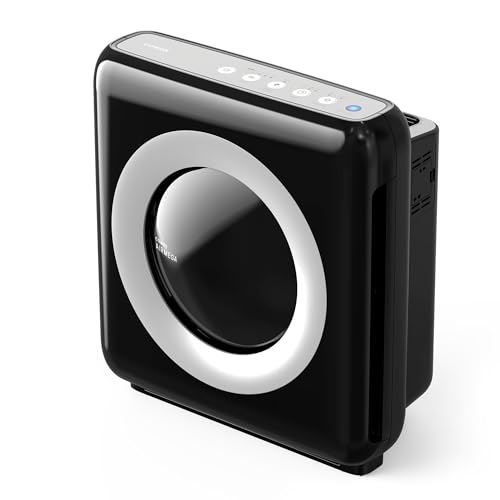
Coway Airmega AP-1512HH (Mighty)
A long-running true-HEPA unit with a washable pre-filter. Reliable and efficient for a bedroom or office; compare its listed CADR with the EPA chart for your room.
$229.99Shop Now - Best smart-app pick
Levoit Vital 200S-P Smart Air Purifier
HEPA purifier with an app and auto mode. Size it by its listed CADR against the EPA chart. It supports the cleanup and does not remove growth on surfaces.
$169.96Shop Now - Best compact pick
Levoit Core 300-P Air Purifier
Compact purifier with a HEPA-grade filter for a bedroom or home office, not a whole floor. Read the CADR on the listing and match it to the EPA chart.
$84.99Shop Now - Best for active remediation
AlorAir PureAiro HEPA Pro 770 Air Scrubber
A contractor-style HEPA air scrubber that can be ducted to create negative pressure during tear-out, the setup EPA describes for limited containment. Overkill for daily use, useful during a cleanup.
$555.00Shop Now - Best for musty odors
Winix 5510 (new generation of the 5500-2)
True HEPA plus an activated-carbon filter for odors and an air-quality sensor. The current version of the long-running 5500-2.
$179.99Shop Now



Product prices and availability are accurate as of November 12, 2026 and are subject to change.